OH-SO

RAIDAR
LLM visibility, mapped.
Not ranked.

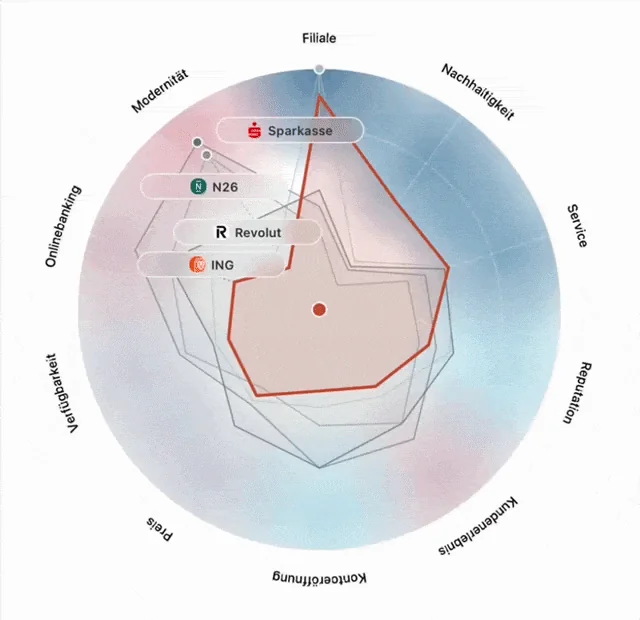
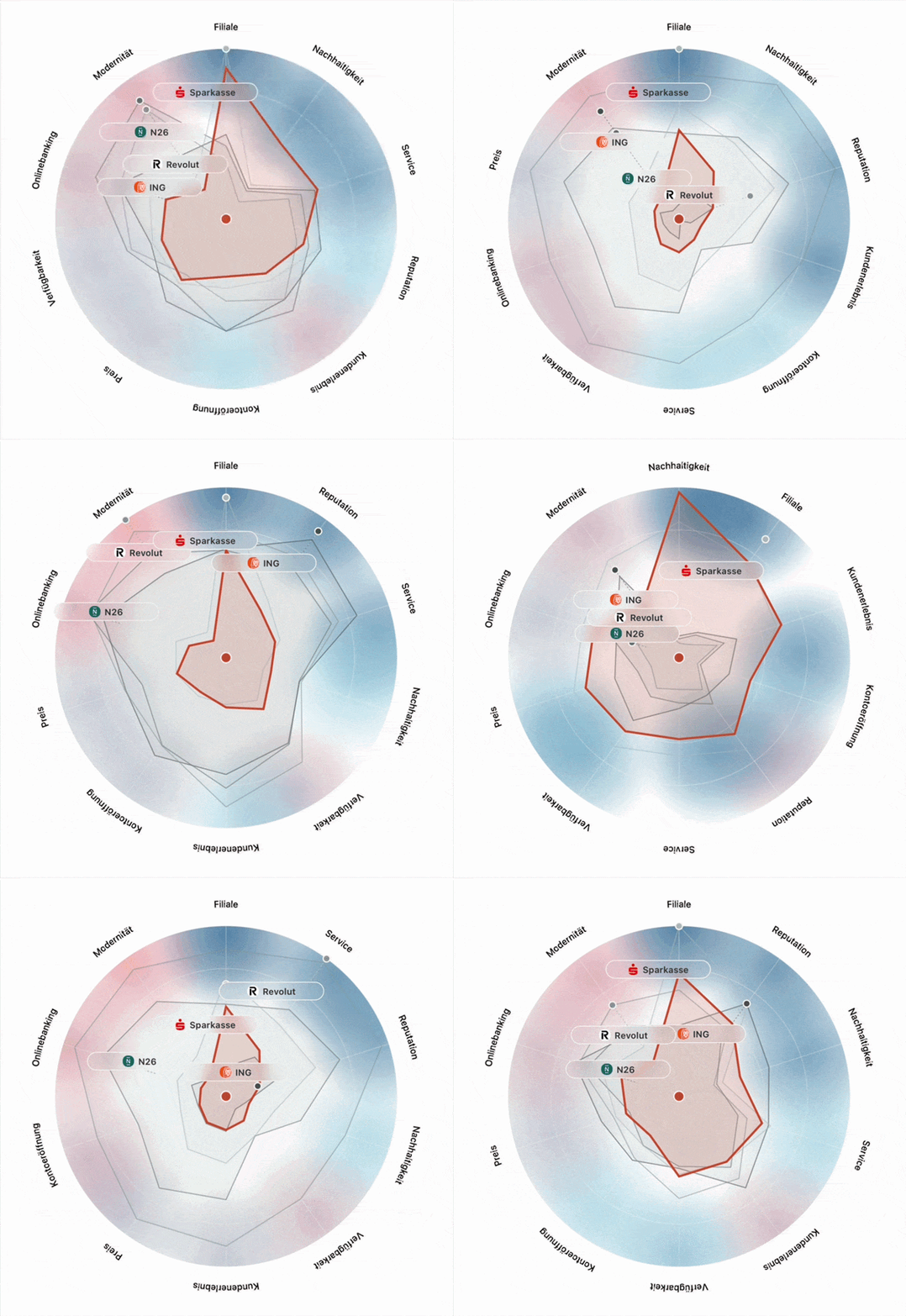
Search is about rankings, AI is not. From a ranking, you can't tell which audience sees which answer, which sources the models trust, or which areas no one has claimed yet. RAIDAR maps all of it across every model, customer segment, and market, down to the sources that feed the answers. Not a ranking. A map that tells you where to move.

RAIDAR whitespace cartography
02 — How

How RAIDAR gives you the full picture.

02.1 · Layer Coverage
/ 3-Layer

The full AI stack.

Your brand lives in three layers inside AI: the training data, the chat answers, and the AI Overviews in Google. Each layer has its own rules. RAIDAR measures all three — so you can discover optimal opportunities everywhere.

Three Layers · Share of Answers
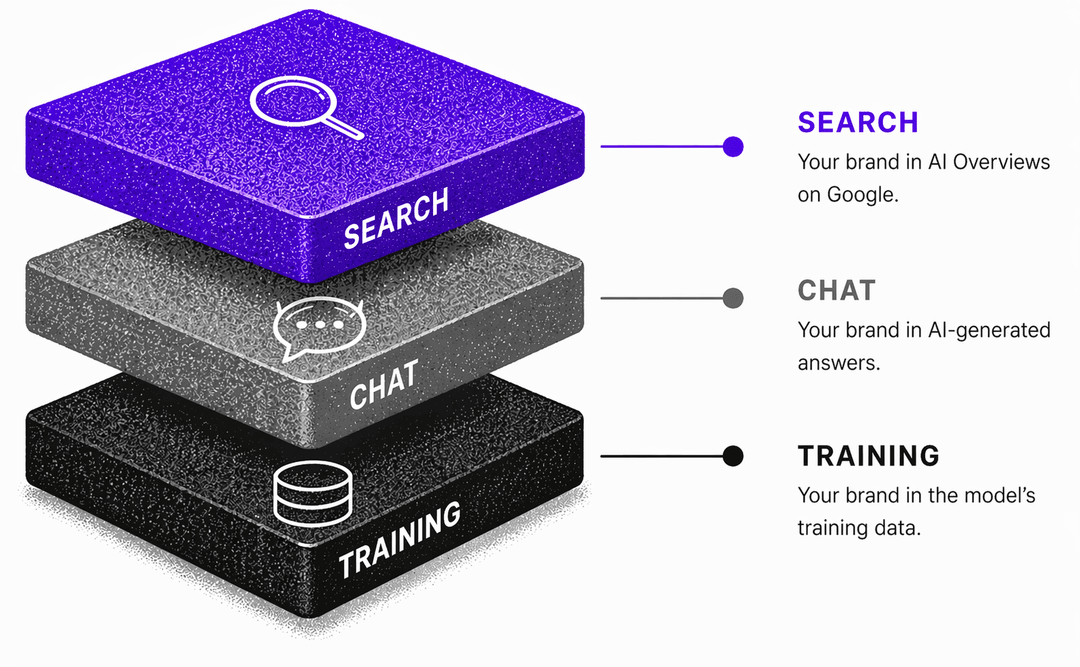
Layer coverage visualization showing three stacked layers: Search (AI Overviews on Google), Chat (AI-generated answers), and Training (model training data)
Decision

Know whether to invest in training-data influence, chat presence, or search-moment optimization — instead of spraying budget across all three.
02.2 · Customer Gradient
/ N-Persona

A look through every lens.

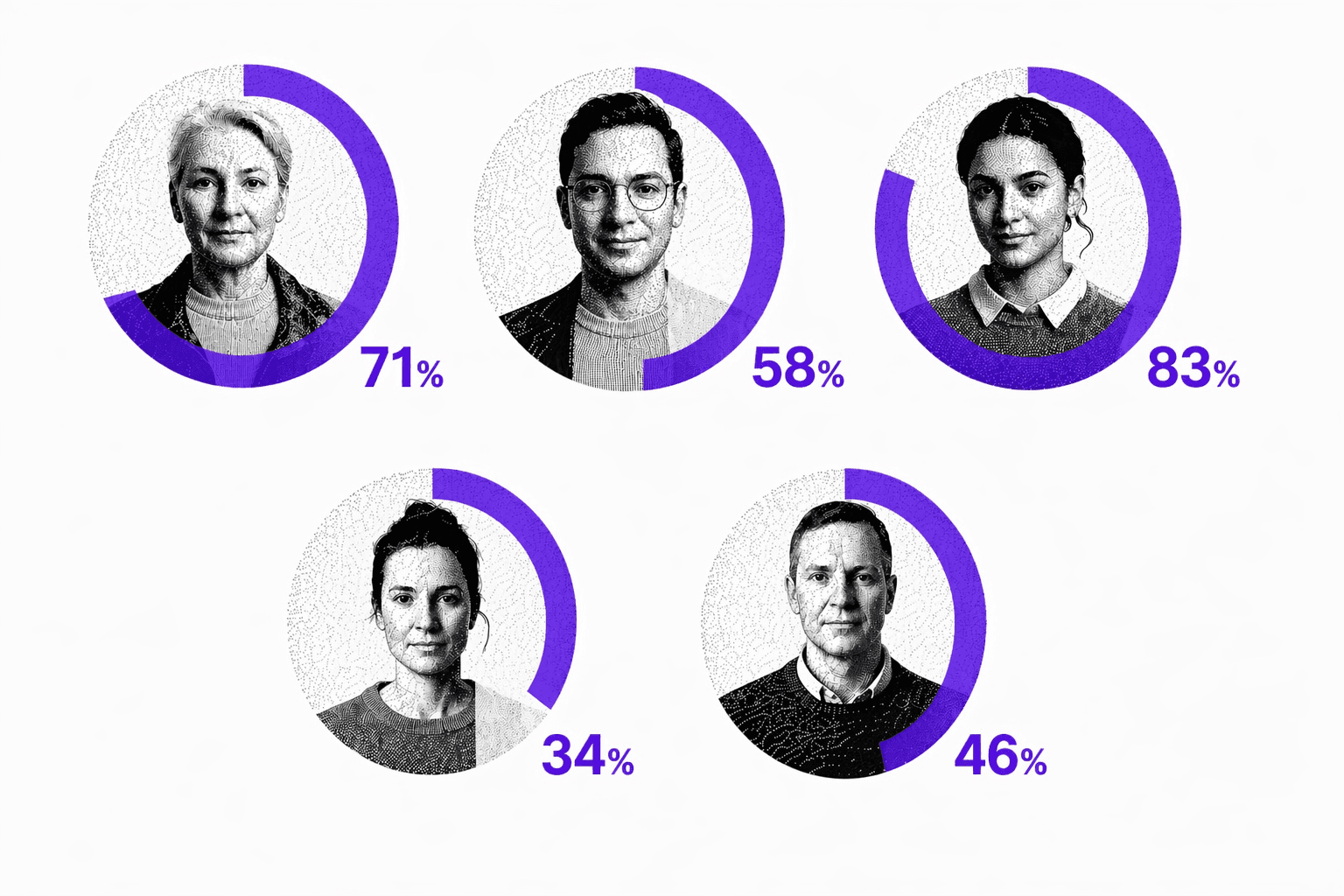
Same question, different answers — depending on who asks and where. RAIDAR measures how your brand position shifts across customer segments, use cases, and markets.

Brand Share · By Segment
Brand share by customer segment visualization showing 5 different customer segments with varying brand share percentages: 71%, 58%, 83%, 34%, and 46%
Decision

Stop averaging your brand. Identify the audience segments where the gap between reality and the AI answer is largest — and move there first.

02.3 · Source Grounding
/ URL-Level

The sources behind every answer.

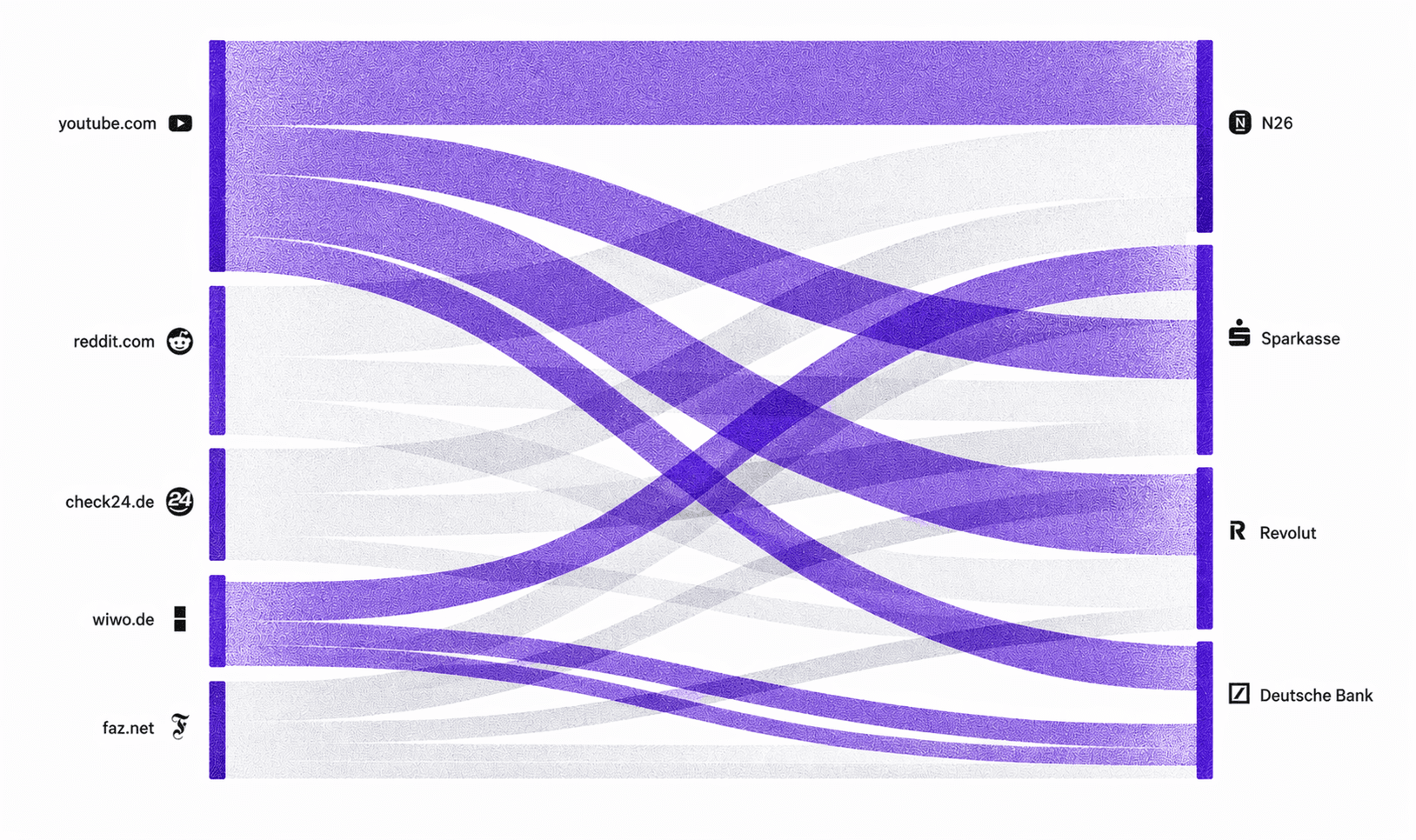
Some sources support you, some boost the competition. Some high-authority sites mention everyone except you. RAIDAR tracks every source the models cite, down to the URL.

Sources · Weight & Flow in Answers
Sankey diagram showing source grounding - how different websites (youtube.com, reddit.com, check24.de, wiwo.de, faz.net) connect to and influence brand mentions for N26, Sparkasse, Revolut, and Deutsche Bank
Decision

Stop writing content and hoping. Get the short list of URLs your competitors own — and the ones you could realistically claim this quarter.

02.4 · Query Resolution
/ Fan-Out

An ongoing journey.

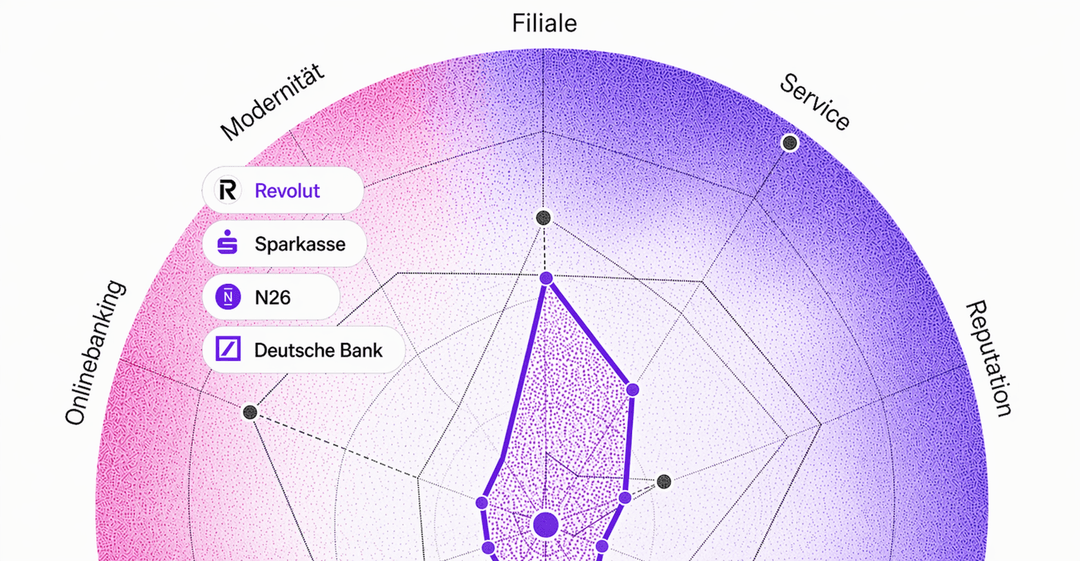
The terrain keeps moving. So should you. Our team can keep working with yours after the first map — turning findings into priorities, writing the content that needs writing, and re-measuring to see what's changing.

Discovering Open Territory
Radar chart comparing brand positioning across multiple dimensions (Filiale, Service, Reputation, Onlinebanking, Modernität) for Revolut, Sparkasse, N26, and Deutsche Bank
Decision

Run RAIDAR once — or run it as a system with hands-on support across strategy, content, and tech.

03 — Resolution

Choose how much detail you need.

RAIDAR comes in three resolutions. The more prompts we fan out, the finer the map. Higher resolution just sees more uncharted territory for your business to conquer.

TIER 01 — ENTRY
8K
prompts
Your first map of a single category. Ideal for an initial scan, a launch diagnostic, or entering a new market.
TIER 02 — STANDARD
16K
prompts
The workhorse tier. Full audience coverage, full source grounding. The map you run a quarterly strategy on.
TIER 03 — MAXIMUM
32K
prompts
Complete market coverage. Every persona, every sub-segment, every long-tail territory. For category leaders and contested markets.

All tiers: HD by default. Statistically validated. Confidence intervals on every figure.

04 — PHASES

From kickoff to first map in three steps.

PHASE 1 — DEFINE

We start with a workshop. Together we define your brand, category, competitors, and the questions that matter. The query set gets calibrated to your market — not a template.

PHASE 2 — DEPLOY

RAIDAR fans out thousands of prompts across the models your customers actually use — GPT, Claude, Gemini, and beyond. Every response is parsed, classified, and placed on the map.

PHASE 3 — DISCOVER

You get an interactive dashboard. Your team explores the map, filters by customer segments, market, source, or layer, and finds the moves worth making.

05 — Perspectives

Different views on the same map.

MARKETING LEADS

Own the narrative before AI shapes it.

Steer brand positioning with evidence, see how your brand is framed across models and where it drifts.

PRODUCT LEADS

Find the open territories where new products can be born.

Spot demand before competitors name it — discover the questions your category generates that no brand is answering yet.

CONTENT LEADS

Write copy that gets cited, not just read.

Turn content strategy into citation strategy — see which sources LLMs actually pull from, and write for them.

ECOM LEADS

Win the last conversation before the final click.

Influence the pre-purchase conversation you never saw, know how your brand shows up when customers ask AI what to buy.

Discover your brand through AI's eyes.

15 minutes. No deck. Promise.

Book a demo
Built byOH-SO
Powered byWPP
Audited byStatista
06 — FAQ

Frequently asked questions.

SEO was built for a world with one dominant gatekeeper: Google. Optimization meant winning a single ranked list by targeting keywords, building backlinks, and polishing meta tags. AEO — Answer Engine Optimization — operates in a fundamentally different landscape. Instead of one search engine, there are dozens of AI models with different training data, different reasoning patterns, and different answer styles. Instead of ten blue links, users get synthesized answers that may not link out at all. Instead of keyword matches, models interpret intent, context, and audience. RAIDAR is built for this new reality:it doesn't chase ranks on a single engine — it maps how your brand shows up across the entire AI landscape, and where you can influence that picture.
A ranking gives you a single coordinate: position 3 of 10 for a given keyword. Useful, but flat. Cartography gives you a topography — a multi-dimensional map that shows where your brand is visible, where competitors own the space, how perception shifts across audiences, which sources feed the answers, and — most importantly — where the whitespaces are. A whitespace is a relevant query space where neither you nor strong competitors dominate yet. Cartography turns AI visibility from a scoreboard into a strategic map: you don't just see where you stand, you see where to move next. It's the difference between measuring a data point and navigating a market.
Most AI visibility tools give you a score — a ranking analog for the LLM era. We think that misses the point. RAIDAR gives you a topography: where you appear, for which audience, grounded in which sources, and which unowned territory exists. The score tells you you are losing. The map tells you where to move.
AI visibility isn't a single surface — it's a stack of three distinct layers, and RAIDAR maps all of them. Layer one is the training content: the articles, reviews, forums, and databases that models ingest when they learn. This layer shapes what a model knows about your category and brand long before any user asks a question. Layer two is the chat interface: the answers users actually see when they prompt ChatGPT, Gemini, or Claude directly. This is where perception gets formed at scale. Layer three is Google AI Overviews and other search-embedded AI surfaces: the moment search and answers converge. Each layer has different dynamics, different leverage points, and different optimization strategies — together they form the complete AI visibility stack.
The same question produces radically different answers depending on who's asking and where. A prompt like "best laptop for video editing" yields one answer for a professional creator in New York, another for a student in Berlin, and a third for an enterprise buyer in Tokyo. RAIDAR's Customer Gradient measures these shifts systematically. We run identical query structures across audience customer segments, use cases, and geographic markets — then map how your brand's position, sentiment, and associated attributes change. The result: a resolved picture of where your brand is strong, where it's weak, and which audience segments represent the biggest upside. Traditional tools treat AI visibility as one number. RAIDAR treats it as a gradient you can navigate.
Modern LLMs increasingly ground their answers in specific sources — citing URLs, referencing publications, and pointing to data. Source Grounding is RAIDAR's URL-level analysis of which sources LLMs actually rely on when they talk about your category. You see which sources support your brand's position, which sources boost competitors, and which high-authority sources are missing your brand entirely. That last category is the most actionable: it turns content strategy from guesswork into a concrete target list. Instead of writing more content and hoping, you know exactly which publications, reviews, comparison sites, and forums to prioritize — and what narrative to bring when you show up there.
Query Resolution is RAIDAR's query fan-out engine. Rather than testing a handful of obvious prompts, we generate thousands of semantically related variations across intent types, funnel stages, audiences, and geographies. This massive scan shows not just where you stand today, but where the competitive field is thin. Whitespaces are query spaces with real demand where no brand dominates — windows to reposition your product, launch new messaging, or build category ownership before competitors notice. Without fan-out at this scale, whitespaces stay invisible. With it, they become a prioritized roadmap.
RAIDAR covers every relevant model in your market — including OpenAI's ChatGPT, Google's Gemini, Anthropic's Claude, and other LLMs that shape purchase decisions in your category. Coverage isn't static: as new models gain user adoption or reshape the competitive landscape, we expand. We also track model-specific behavior, because a brand that looks strong in one model can be nearly invisible in another. RAIDAR surfaces those asymmetriesso you don't optimize against an average that doesn't exist — you optimize against the specific models your customers actually use.
Nothing but a browser and a brand. RAIDAR is 100% SaaS — there's no script to install, no data pipeline to wire up, no engineering ticket to open. Marketing, brand, and content teams can onboard, define their competitive set and audiences, and be looking at dashboards within the same day. Enterprise customers with specific compliance, SSO, or API needs get a tailored setup, but the default experience is deliberately self-serve. RAIDAR was built for the people who own the brand conversation, not for the people who maintain the data warehouse.
AI outputs are probabilistic, which makes naive single-prompt tests unreliable. RAIDAR solves this with scale and statistical discipline. Every insight is backed by large sample sizes — often hundreds to thousands of queries per topic — run across multiple models and repeated over time to control for model drift and stochastic variation. A multi-stage validation framework and over fifteen statistical and mathematical models filter noise from signal, and our methodology has been independently proven by Statista. The result: findings you can defend in a boardroom and act on with confidence, not vibes dressed up as insights.
RAIDAR is built by OH-SO Digital, a team of AdTech and MarTech pioneers from Europe. In the 1990s, they developed ADTRACTION — one of the world's first ad tracking tools. Later they built NEXT AUDIENCE, the world's first data management platform, grown out of a retargeting ad server stack that was years ahead of the market. That lineage matters: RAIDAR isn't a feature bolted onto a generic analytics suite. It was architected from the ground up by a team that has spent three decades building the measurement and targeting infrastructure that the digital industry now takes for granted. AEO is the next frontier, and we're building the map.
Absolutely. RAIDAR is designed for self-serve exploration, but we know that turning data into action often benefits from expert guidance. Our team can support you at every stage: setup and prompt calibration to ensure the query set reflects your actual market and competitive landscape, analysis and interpretation to extract the highest-leverage insights from your dashboards, and execution of tactical and strategic measures— from content creation and tech optimization to discover new market opportunities for your brand. Whether you need a one-time workshop or ongoing advisory, we're here to help you move from map to action.